Most Common Plastic Surgery Procedures in Bellevue: Your Questions Answered
From the Keller funnel to mini facelifts — Dr. Kristopher Day covers the procedures, techniques, and misconceptions patients ask about most.
By Dr. Kristopher M. Day, MD, FACS | Pacific Sound Plastic Surgery, Bellevue, WA | March 2026
If you're researching plastic surgery in Bellevue, Washington, you probably have a long list of questions — and rightfully so. The field of plastic surgery is rich and diverse, encompassing procedures from the face to the body, each with nuances that can significantly affect your results and recovery. At Pacific Sound Plastic Surgery, we see patients from across the Bellevue, Kirkland, Redmond, Seattle, and Mercer Island area, and the same core questions come up again and again.
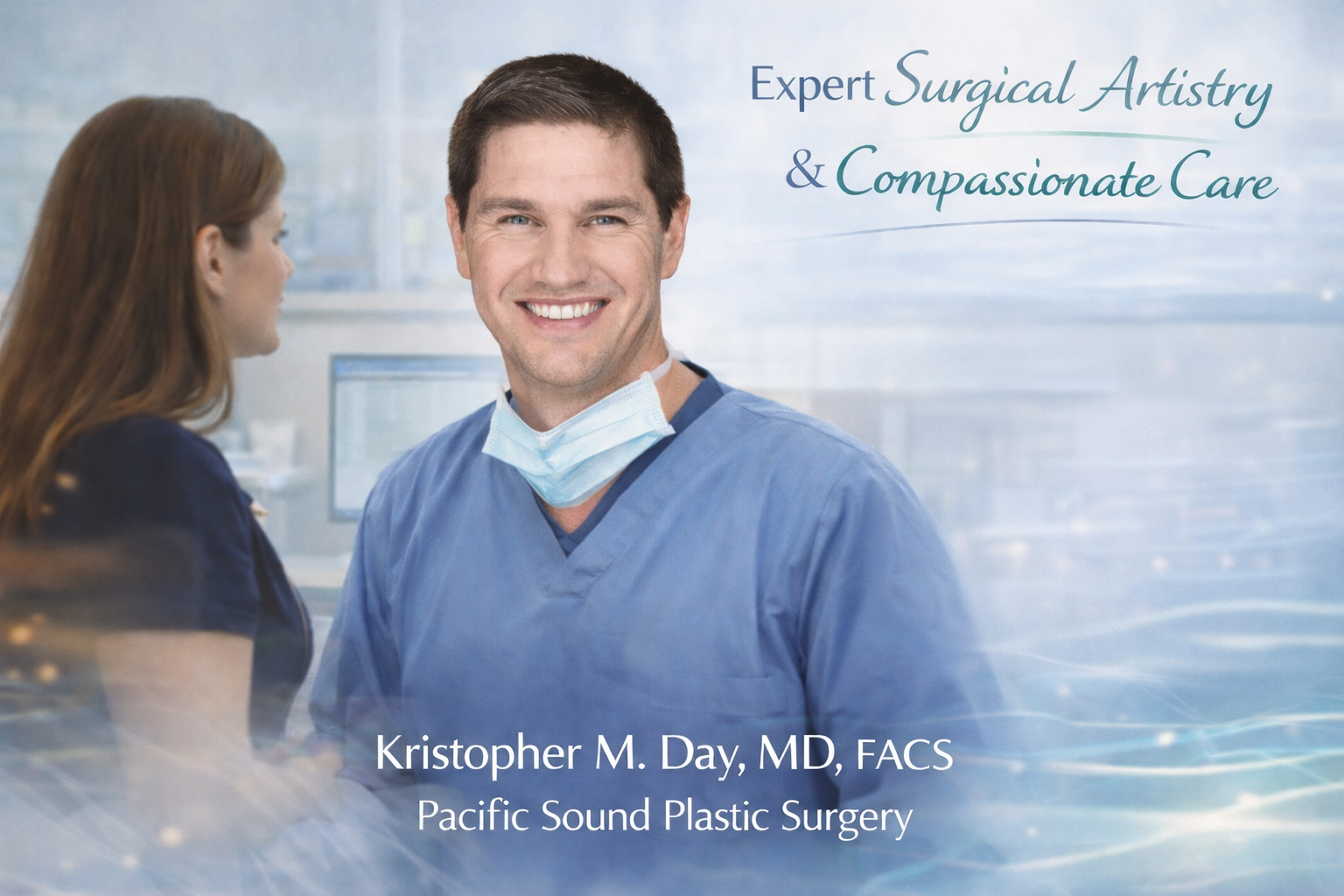
Below, Dr. Kristopher M. Day, MD, FACS — double board-certified, Ivy League Trained at Brown University, and the only craniofacial fellowship-trained plastic surgeon in the Bellevue market — addresses the most common procedures performed at the practice and the questions patients bring to consultation.
The Most Common Plastic Surgery Procedures at Our Bellevue Practice
Plastic surgery is a field that operates on patients from head to toe, focused on the form and function of the human body. At Pacific Sound Plastic Surgery, the most commonly performed procedures span the face, breast, and body categories — and many patients choose to combine procedures for efficiency and comprehensive results.
Procedures Performed Most Frequently at Our Practice
- Body: Tummy tuck (abdominoplasty), liposuction, mommy makeover, Brazilian Butt Lift (BBL)
- Breast: Breast augmentation, breast lift (mastopexy), breast reduction, combination augmentation-mastopexy
- Face: Facelift and neck lift, rhinoplasty, otoplasty (ear pinning), eyelid lift (blepharoplasty)
- Combination Procedures: Liposuction with tummy tuck, fat grafting with facelift, 360° liposuction with fat transfer to buttock
Many patients come in focused on one area but discover during consultation that combining procedures — such as a mommy makeover that addresses both the abdomen and breasts at once — offers better value and a single recovery period. Dr. Day evaluates each patient individually to determine the safest and most effective approach for their goals.
[Recommended image: Before/after gallery or Dr. Day in consultation — sourced from approved patient consent library]
"The results exceeded my expectations, 10 fold, and I couldn't be happier. The office staff is supportive and quick to respond as well."
Breast Augmentation in Bellevue: The Keller Funnel & No-Touch Technique
When patients ask about breast augmentation technique, one of the most important topics is what's known as the no-touch technique — and the device that makes it possible: the Keller funnel.
How the Keller Funnel Works
The Keller funnel is an FDA-approved, sterile, single-use device that functions like a piping bag — allowing the implant to transfer directly from its sealed packaging into the body without any manual handling. Even in a sterile surgical environment with double-gloved hands, this zero-contact approach offers an additional layer of protection.
The implant arrives in a double-sealed package. Antibiotic solution is added, and the implant glides through the funnel directly into the chest. The dynamic properties of the funnel's material allow the implant to slide through without compression or manipulation. The result: the implant travels from factory packaging to its final position with no contact whatsoever.
This matters clinically. Bacterial contamination during implant placement is a recognized contributing factor to capsular contracture — one of the most common complications of breast augmentation. Minimizing handling minimizes that risk. For patients in Bellevue considering breast augmentation, understanding the technique your surgeon uses is worth exploring during your consultation.
Questions About Breast Augmentation?
Dr. Day addresses technique, implant type, incision placement, and recovery at your personal consultation in Bellevue.
(425) 818-8991 Request a Consultation Learn About Breast AugmentationThe Truth About Transaxillary (Armpit) Breast Augmentation
Transaxillary breast augmentation — placing implants through an incision in the armpit to avoid a visible scar on the breast — sounds appealing in theory. But the data tells a different story.
According to a peer-reviewed study published in a respected plastic surgery journal — and co-authored by Dr. Day — only about 2% of breast augmentations nationally are performed via the transaxillary approach. The reason this number is so low is not arbitrary: the technique is associated with a meaningfully higher complication rate compared to the standard inframammary fold incision (placed in the natural crease beneath the breast).
Large database analyses from the American Society of Plastic Surgeons — the world's foremost organization of plastic surgery professionals — consistently show the inframammary incision to be among the safest approaches in terms of complication rate. While the idea of no visible scar on the breast is understandably attractive, patients must weigh that aesthetic trade-off against the evidence-based risk profile.
Key Takeaway: Incision Placement Matters
- Transaxillary approach = approximately 2% of U.S. breast augmentations
- Inframammary fold = lowest complication rate of any approach (multiple large studies)
- Dr. Day is a co-author on landmark database studies examining incision safety
- Discuss all incision options — and their risk profiles — at consultation
"Dr. Day is a master of his craft. With each and every visit, he clearly lays out multiple, empathetic strategies for achieving your cosmetic goals."
[Recommended image: Consultation setting — patient and surgeon reviewing procedure options]
Who Actually Qualifies for a Drainless Tummy Tuck in Bellevue?
The drainless tummy tuck is one of the most frequently asked-about techniques at our Bellevue practice — and one of the most frequently misunderstood.
Yes, avoiding surgical drains would be easier for everyone — for patients managing recovery at home and for the surgical team managing post-operative care. But conscientious surgeons recognize that this technique is appropriate for only a select group of patients, not as a universal standard.
Who Is the Best Candidate?
The drainless approach is most appropriate for patients with a relatively lower body mass index and for those undergoing a mini tummy tuck. The reasoning is straightforward: a mini tummy tuck requires a shorter incision and a smaller surface area of tissue dissection, which means less fluid accumulates during the healing process — which is precisely what drains are designed to manage.
When a drainless tummy tuck is applied to patients who are not ideal candidates, the risk of developing a seroma — a fluid collection beneath the skin — increases significantly. Resolving a seroma can require a return to the operating room, which no patient wants after an elective procedure.
Drainless Tummy Tuck: What Patients Should Know
- Appropriate for a selective patient population — not a universal standard
- Best suited to patients with lower BMI undergoing mini tummy tuck
- Inappropriate candidacy increases seroma risk and potential surgical revision
- Always discuss drainage approach directly with your surgeon at consultation
- Note: Mini tummy tuck at Pacific Sound Plastic Surgery includes full muscle repair
If a drainless approach matters to you, it's absolutely worth raising during your tummy tuck consultation in Bellevue — Dr. Day addresses it with every patient who asks. The key is ensuring the decision is based on your anatomy, not just your preference.
Facelift vs. Mini Facelift: Which Is Actually Right for You?
Few topics in facial rejuvenation generate as much patient confusion as the difference between a mini facelift and a full facelift — and marketing hasn't helped. The word "mini" implies something gentler, less dramatic, and perhaps more accessible. The reality is more nuanced.
When a Mini Facelift Makes Sense
A mini facelift addresses the face alone, with an incision that does not extend past the lower earlobe and behind the ear (which is required for a neck lift). It is genuinely appropriate for patients who identify and address early signs of facial aging before they become pronounced. Think of it as an early-intervention option for those who are proactive.
Why Most Patients Ultimately Need a Full Face and Neck Lift
Here is the clinical reality at a practice like Pacific Sound Plastic Surgery: the vast majority of patients — more than 95% — who undergo a facelift in our Bellevue practice receive a combined face and neck lift. That's because most people don't seek out surgical facial rejuvenation the first time they notice early changes. They consider it for years, deliberate, save, and finally decide when they feel the time has genuinely arrived. By that point, the neck almost always requires treatment too.
The standard face and neck lift has been the benchmark procedure for decades — and it remains so because it works. All alternative procedures, mini facelifts included, are ultimately measured against it. A full face and neck lift can turn back the clock 10–15 years with results that look natural, not pulled.
Mini Facelift vs. Full Face & Neck Lift at a Glance
- Mini Facelift: Face only · No neck incision · Best for early-stage aging · Less recovery
- Full Face & Neck Lift: Face + neck · Standard of care · >95% of cases at our practice · Comprehensive rejuvenation
- Key question: How long have you been thinking about this? If years — you likely need the full procedure.
- Note: Neck lift is a standard component of a facelift, not a separate add-on service
What a Facelift Does — and Doesn't — Include
A common misconception is that a facelift addresses the entire face, including the eyes and brow. It does not. Understanding the anatomy is important before consultation.
A facelift addresses the lower two-thirds of the face — from below the eyes downward, including the jowls, lower cheeks, and neck. The upper face — the forehead and brow — is the domain of a brow lift. The eyelids themselves require blepharoplasty (eyelid lift surgery), a distinct procedure with its own approach and recovery.
Common Procedures Often Combined With Facelift
Many Bellevue patients choose to combine their facelift with complementary procedures for a more complete result. The most common additions include fat grafting to the cheeks (restoring volume lost with age), eyelid lift (blepharoplasty), brow lift, and buccal fat excision for improved midface definition. These are all separate procedures — none of them are automatically included in a facelift — and each should be discussed individually during consultation so your expectations match your outcome.
"His skill, artistry, and compassion are unmatched. From the very first consultation, he made me feel comfortable, informed, and genuinely cared for."
[Recommended image: Before/after facelift result — sourced from approved patient consent library]
Ready to Explore Your Options?
Whether you're considering a single procedure or a combination, Dr. Day creates a personalized plan based on your anatomy, goals, and timeline. Serving Bellevue, Seattle, Kirkland, Redmond, and Mercer Island.
(425) 818-8991 Schedule a ConsultationFrequently Asked Questions About Plastic Surgery in Bellevue
What are the most common plastic surgery procedures performed in Bellevue? +
The most frequently performed procedures at Pacific Sound Plastic Surgery include tummy tuck, breast augmentation, breast lift, breast reduction, combination augmentation-mastopexy, facelift with neck lift, rhinoplasty, otoplasty, and eyelid surgery. Many patients also combine body procedures like liposuction with their primary surgery or add fat grafting to facial rejuvenation procedures.
What is the Keller funnel and why does it matter for breast augmentation? +
The Keller funnel is an FDA-approved sterile device that transfers a breast implant directly from its sealed packaging into the chest without hand contact — a method known as the no-touch technique. By eliminating manual implant handling, this approach reduces bacterial contamination risk, which is a known contributing factor to capsular contracture. It is one of several evidence-based techniques Dr. Day uses to minimize complication risk during breast augmentation.
Is transaxillary (armpit) breast augmentation safe? +
Transaxillary augmentation is performed in only approximately 2% of cases nationally, and carries a higher complication rate than the standard inframammary fold (under-breast) incision. Multiple large database studies — including research co-authored by Dr. Day — demonstrate the inframammary approach has among the lowest complication rates of any incision method. Patients should discuss all incision options and their evidence-based risk profiles during consultation.
Who is a good candidate for a drainless tummy tuck in Bellevue? +
A drainless tummy tuck is selectively appropriate for patients with a lower body mass index, particularly those undergoing a mini tummy tuck procedure. It is not a standard approach for all patients. When applied to patients who do not meet the criteria, the risk of seroma (fluid collection) increases significantly and may necessitate a return to the operating room. Candidacy is assessed individually at consultation.
What is the difference between a mini facelift and a full facelift? +
A mini facelift addresses the face only, without extending the incision past the earlobe into the neck. A full facelift includes a neck lift in more than 95% of cases at our practice and provides comprehensive rejuvenation of the face and neck. Most patients who have been contemplating surgery for multiple years require a full face and neck lift. A mini facelift is best suited to patients addressing aging changes early, before they become significant.
Does a facelift include an eyelid lift or brow lift? +
No. A facelift addresses the lower two-thirds of the face — below the eyes and including the neck (when a neck lift is included). The eyelids require a separate blepharoplasty procedure, and the forehead and brow are treated with a brow lift. These procedures can be performed simultaneously with a facelift, but they are distinct and must be discussed individually during your consultation.
Can I combine multiple plastic surgery procedures in one operation in Bellevue? +
Yes — combining procedures is extremely common and often clinically appropriate. A mommy makeover, for example, combines breast and abdominal procedures in a single operation with one recovery period. Facelift patients frequently add fat grafting, eyelid surgery, or brow lift. Dr. Day evaluates safety parameters carefully to determine which combinations are appropriate based on your health, anatomy, and surgical goals.
How do I schedule a plastic surgery consultation with Dr. Day in Bellevue? +
Call our Bellevue office directly at (425) 818-8991 or submit a consultation request online. Pacific Sound Plastic Surgery is located at 1260 116th Ave NE, Suite 100, Bellevue, WA 98004. We serve patients from Bellevue, Seattle, Kirkland, Redmond, Mercer Island, Issaquah, and Renton.
Kristopher M. Day, MD, FACS
Double Board-Certified Plastic Surgeon · Pacific Sound Plastic Surgery · Bellevue, WA
Dr. Day is double board-certified by the American Board of Plastic Surgery and the American Board of Surgery, Ivy League Trained at Brown University, and holds craniofacial fellowship training — the only surgeon with this background serving the Bellevue market. He has authored and co-authored 20+ peer-reviewed publications and holds memberships in 12 professional surgical societies, including the Migraine Surgery Society. Learn more about Dr. Day →
Reviewed and approved for publication by Dr. Kristopher M. Day, MD, FACS. Content on this page is for educational purposes only and does not constitute medical advice. Individual results vary. Schedule a personal consultation to determine whether any procedure is appropriate for your specific anatomy and goals.
Take the Next Step at Pacific Sound Plastic Surgery
Double board-certified, Ivy League trained, and the only craniofacial fellowship-trained plastic surgeon in Bellevue. Your consultation is a personal conversation — not a sales pitch.
(425) 818-8991 Request a Consultation OnlinePacific Sound Plastic Surgery · 1260 116th Ave NE, Suite 100 · Bellevue, WA 98004