Gender-Affirming Body Contouring in Bellevue
Gender-affirming body contouring refers to plastic surgery techniques that are used to reshape the body into a more masculine or more feminine physique, as desired. Common procedures include liposuction (fat removal) and fat redistribution (also known as fat grafting or “reverse liposuction”).
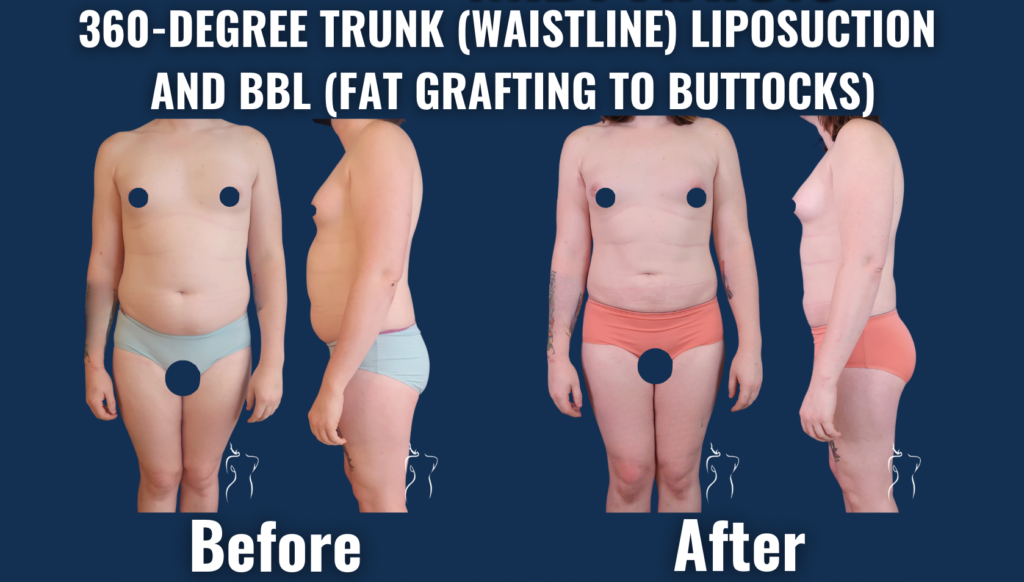
Because the bony framework of the body cannot be changed with hormone therapy, body contouring focuses on reshaping the overlying soft tissues to achieve the desired shape. In feminizing body contouring, liposuction to trim the waist, trunk, and flanks may be combined with fat grafting to round out the hips, creating a more feminine waist-to-hip ratio. In masculinizing body contouring, liposuction of the hips and thighs may be combined with fat grafting to the lateral flanks to create a more rectangular trunk contour.
Double Board-Certified (ABPS + ABS)
Ivy League Trained
Highly Rated Bellevue Plastic Surgeon
Proudly Serving Bellevue, Seattle, Kirkland, Redmond, Mercer Island, Issaquah & Renton
What Is Gender-Affirming Body Contouring?
Gender-affirming body contouring — sometimes called transgender body contouring — refers to a group of surgical techniques used to reshape the body into a more masculine or more feminine physique. The most common procedures are liposuction (fat removal) and fat grafting (fat redistribution, also known as “reverse liposuction”). It is one of the most requested body procedures in gender-affirming care.
Because hormone therapy cannot change the underlying bony framework of the body, body contouring focuses on reshaping the overlying soft tissues to achieve the desired shape. For feminizing transformations, liposuction of the waist, trunk, and flanks is often combined with fat grafting to the hips and buttocks — and sometimes the breasts — to create a more defined waist-to-hip ratio. For masculinizing transformations, liposuction of the hips and thighs is often combined with fat grafting to the lateral flanks to create a broader, more rectangular trunk contour.
Benefits Of Gender-Affirming Body Contouring
Why Bellevue Patients Choose Gender-Affirming Body Contouring
For many patients gender affirming body contouring is an important step in bringing the body’s physical contour into alignment with their gender identity. The surgical plan is built around each patient’s anatomy and goals — and discussed in detail during your consultation.
Common Benefits Patients Report
- A more feminine or more masculine body contour, tailored to your goals
- Combined liposuction and fat grafting performed in a single surgery in most cases
- Use of autologous fat (your own fat) for grafting — no implants or foreign materials required
- A defined waist-to-hip ratio for feminizing transformations
- A broader, more rectangular trunk contour for masculinizing transformations
- Results that complement other gender-affirming care
- A consultation-based surgical plan customized to your anatomy
"Dr. Day was able to fit me in so soon for a consultation, and not a month later a surgery date! He made my experience incredibly easy and created a safe space to express what I was looking for in my procedure. Definitely would be recommending him to a ton of my friends seeking gender affirming care."
Ksenia, Patient Google Review
Google Review ★★★★★
Am I A Good Candidate For Gender-Affirming Body Contouring?
Candidacy Overview
The best candidates for gender-affirming body contouring are patients in good overall health who have realistic expectations about what soft-tissue contouring can and cannot change, and a clear personal motivation for the procedure.
Dr. Day evaluates each patient individually during a private consultation. The table below gives a general framework for understanding candidacy:
Not Sure If You're a Candidate?
Candidate Profile | Typically Good Candidate? | Notes |
|---|---|---|
Seeking body contour aligned with gender identity | ✅ Yes | Core candidate — primary motivation |
Weight stable for at least 6 months | ✅ Yes | Stable weight protects long-term contour |
Adequate fat available for harvest | ✅ Yes | Required when fat grafting is part of the plan |
Stable, healthy weight (not planning major weight loss) | ✅ Yes | Weight changes affect implant appearance |
Realistic expectations about soft-tissue contouring | ✅ Yes | Body contouring reshapes soft tissue, not the bony framework |
Non-smoker or willing to quit before surgery | ✅ Yes | Smoking significantly increases complications |
General good health, no uncontrolled conditions | ✅ Yes | Standard surgical clearance required |
Currently pregnant or breastfeeding | ❌ No | Wait until 3–6 months after weaning |
Active infection or unresolved health issues | ❌ No | Clearance from physician required first
|
Actively losing weight | ⚠️ Consult | Wait until weight has been stable for at least 6 months |
Insufficient donor fat for desired graft volume | ⚠️ Consult | May require a staged plan or modified approach |
Pursuing insurance coverage for surgery | ⚠️ Consult | WPATH support letter typically required, obtained by the patient |
The Process And Recovery
Your Consultation with Dr. Day
Your gender-affirming body contouring journey begins with a private one-on-one consultation with Dr. Day. This appointment is not a sales meeting — it’s a medical conversation. Dr. Day will review your medical history, examine your body contour, and discuss your goals for feminization or masculinization in detail. You’ll have the opportunity to ask questions and explore your surgical plan before any decision is made.
The Surgical Process — What to Expect
Step | Details |
|---|---|
Pre-Operative Preparation | You will receive pre-operative instructions covering medications to avoid, fasting requirements, and what to arrange for your recovery at home. |
Anesthesia | Gender-affirming body contouring is performed under general anesthesia administered by either a board-certified anesthesiologist or certified registered nurse anesthetist (CRNA). The procedure typically takes 2–4 hours depending on the number of liposuction areas and the volume of fat grafting required. |
Liposuction & Fat Harvest | Dr. Day makes small 2–3mm “poke hole” incisions in the donor areas (typically the waist, flanks, hips, or thighs, depending on your plan) and removes fat through liposuction. |
Fat Processing | The harvested fat is processed and purified for transfer. The fat removed from one area becomes the material used to add volume to another — sometimes called “reverse liposuction.” |
Fat Grafting | The processed fat is injected in small, precise increments into the target areas — the hips, buttocks, lateral flanks, or breasts, depending on your goals. Ultrasound guidance is used for safety when fat grafting to the buttocks. |
Closing & Recovery Suite | The small liposuction incisions are closed with dissolvable sutures or steri-strips. You will spend time in the recovery suite before being released. A driver is required — you cannot drive yourself home. |
Days 1-3
Low-grade activity is encouraged starting the day after surgery. Short walks, light movement around the home. The rule is no grimace, grunt, strain, or sweat. Compression garment worn 23 hours per day.
Days 3-5
Most patients return to desk work within 3–5 days of liposuction and fat grafting. Continue short walks and light daily activity. No strenuous activity or heavy lifting yet.
Weeks 2
Typical return to full activity for most patients. Resume normal exercise gradually. Follow-up appointment with Dr. Day to assess healing and clear next activity milestones.
Weeks 2-3
For patients with fat grafting to the buttocks: avoid direct sitting on the buttocks during this period (a BBL pillow is used). Compression garment continues 23 hours per day for at least the first 3 weeks.
Months 3-6
Final contour emerges as swelling fully resolves and grafted fat stabilizes. Approximately 40–50% of the transferred fat is absorbed by the body during this period; the surviving fat is permanent and behaves like the patient’s native tissue. Results are stable.
"I don't even really have the words to describe what Dr. Day has done for me. Transformed me into the person I want to be is really the best description. It was like he took the idea out of my head and just made it happen."
— AJ, Patient Google Review
Gender-Affirming Body Contouring Results
When You'll See Results
Immediately following surgery, your body will appear swollen and bruised in both the donor areas (where liposuction was performed) and the recipient areas (where fat was grafted). The contour you see in the mirror in the first week is not your final result. Swelling, bruising, and surgical tightness are most noticeable in the first one to two weeks. A compression garment is worn 23 hours per day during this phase.
By weeks 3–6, the majority of swelling has resolved and early contour changes are clearly visible. The grafted fat continues to settle and integrate with the surrounding tissue. Final contour typically emerges between 3 and 6 months post-surgery as residual swelling resolves and the surviving fat stabilizes.
How Long Results Last
Gender-affirming body contouring produces durable results when you maintain a stable weight. The fat cells removed through liposuction do not regenerate, so your contour holds long-term as long as your weight remains stable. Of the fat grafted into the target areas, approximately 40–50% is naturally absorbed by the body during the first 3–6 months. The surviving fat behaves like the surrounding native tissue and is durable long-term.
"I had a breast lift with Dr. Day, and I cannot say enough good things about both him and his entire team. From the very first consultation, he made me feel comfortable, informed, and genuinely cared for. He took the time to explain every step, answered all of my questions with patience, and helped me feel completely confident and educated with my decision. The surgery itself went flawlessly, and my results are even better than I imagined; natural, lifted, and perfectly proportioned."
Judy Ann, Breast Surgery Patient
Gender-Affirming Body Contouring Cost in Bellevue
What Affects the Cost
One of the most common questions patients bring to a gender-affirming body contouring consultation is about cost. The largest factor in determining your procedure cost is the time required in the operating room. The facility fee covers anesthesia, equipment, surgical staff, and post-operative recovery. Your final cost is always discussed in detail during your personal consultation with Dr. Day.
- Number of liposuction areas — each area is priced separately
- Volume of fat grafting required, and whether fat is grafted to one or multiple target areas
- Use of energy-based liposuction (Renuvion or VASER) when appropriate for your plan
- Anesthesia and surgical facility fees — both included in your total estimate
- Combined procedures — pairing with abdominoplasty in some masculinizing plans affects total cost
What’s Included in Your Investment
- Surgeon’s fee
- Accredited surgical facility fee (Carillon Point Surgery Center)
- Anesthesia (administered by a board-certified anesthesiologist or certified registered nurse anesthetist)
- Enhanced Recovery After Surgery medication (Exparel)
- Cosmetic surgery coverage (Cosmetasure)
- High-end compression garment (Isavella)
- High-end scar ointment (Biocorneum)
- Swelling and bruising ointment (Arnica)
- Recovery supplements (Clara Recovery Supplements)
- Pre-surgical antiseptic cleansing cloths (Chlorhexidine Anti-Septic Scrub Cloths)
- Post-operative recovery and follow-up care
Financing Options
Pacific Sound Plastic Surgery accepts financing through two trusted healthcare lending partners:
- CareCredit — 6-month financing available
- Alphaeon Credit — flexible credit lines designed for healthcare procedures
Ask our patient care coordinator about financing during your consultation.
Gender Affirming Body Contouring in Bellevue
Your final cost depends on the specific techniques, implant selection, and your individualized surgical plan. Dr. Day will provide a detailed, itemized estimate during your consultation.
Why Choose Dr. Kristopher Day for Gender Affirming Body Contouring
Credentials & Differentiators
In a region with no shortage of plastic surgeons, the patients who choose Pacific Sound Plastic Surgery do so because of what sets Dr. Day apart — credentials, technique, and a genuine commitment to individualized care.
What Sets Dr. Day Apart | Why It Matters for Your Revision |
|---|---|
Double Board-Certified (ABPS + ABS) | Rigorous credentialing across both plastic and general surgery — rare in cosmetic practice |
Ivy League Trained | Ivy League-trained, double board-certified plastic surgeon with extensive experience in complex revision cases |
10+ Years of Revision Experience | Extensive hands-on experience with capsulectomies, pocket changes, and complex implant exchanges |
Accredited Surgical Facilities | All procedures performed at Swedish Medical Center, Carillon Point Surgery Center, Virginia Mason Franciscan Health, or Sound Plastic Surgery Center |
Highly Rated Bellevue Plastic Surgeon | One of the highest-rated plastic surgeons in Bellevue — patients consistently cite trust, communication, and exceptional results |
Individualized Surgical Planning | No revision is treated as routine — every plan is built around your specific anatomy, implant history, and goals |







Frequently Asked Questions
What's the difference between liposuction and fat grafting?
Liposuction removes fat from areas of unwanted prominence — the waist, flanks, hips, or thighs. Fat grafting takes that harvested fat and places it into areas where greater volume is desired, such as the hips, buttocks, or breasts. In gender-affirming body contouring, the two are almost always performed together: fat removed from one area is grafted into another in a single procedure. This combined approach is sometimes called “reverse liposuction.”
What does "reverse liposuction" mean?
“Reverse liposuction” is another name for fat grafting. Standard liposuction removes fat from the body; fat grafting places fat into the body. Dr. Day uses both terms interchangeably with his patients. The fat used in grafting is your own — harvested during the same surgery from your liposuction donor sites, then processed and injected in small, precise increments into the target areas.
What's the difference between feminizing and masculinizing body contouring?
For feminizing body contouring, the goal is typically a more defined waist-to-hip ratio. Liposuction is used to trim the waist, trunk, and flanks, and fat grafting adds volume to the hips, buttocks, and sometimes the breasts. For masculinizing body contouring, the goal is typically a broader, more rectangular trunk contour. Liposuction reduces fullness in the hips and thighs, and fat grafting adds volume to the lateral flanks. Your specific plan is built around your anatomy and goals during your consultation.
What is ultrasound guidance and when is it used?
Ultrasound guidance is a safety standard used during fat grafting to the buttocks. It allows the surgeon to visualize fat placement in real time, ensuring the fat is placed in safe tissue layers and not into deeper muscle. Dr. Day follows current ASPS safety guidelines for all fat transfer procedures, including the use of ultrasound when indicated.
How long is gender-affirming body contouring recovery?
Most patients return to desk work within 3–5 days following liposuction and fat grafting. Full activity is typically resumed by week 2. A compression garment is worn 23 hours per day for at least 3 weeks, and many patients continue wearing it for up to 3 months for optimal contouring. Patients receiving fat grafting to the buttocks must avoid sitting directly on the buttocks for 2–3 weeks (a BBL pillow is used during this period). Final contour emerges over 3–6 months as residual swelling resolves.
Will my results look natural?
Yes. Because gender-affirming body contouring uses your own fat — not implants — the result feels and behaves like native tissue. The fat that survives the grafting process integrates with the surrounding tissue and is durable long-term. Liposuction-removed fat does not regenerate. The final contour is gradual and natural-looking as swelling resolves over 3–6 months.
Can I combine gender-affirming body contouring with other procedures?
Yes — in fact, combining liposuction and fat grafting in a single surgery is the standard approach. The fat removed from one area is processed and grafted into another area in the same procedure. Additional procedures, such as an abdominoplasty in some masculinizing plans, may be considered when appropriate. Dr. Day will determine which combinations are safe and optimal for your specific anatomy and goals during your consultation.
How much fat survives the grafting process?
Approximately 40–50% of the grafted fat is naturally absorbed by the body during the first 3–6 months after surgery. The remaining fat survives long-term, integrates with the surrounding tissue, and behaves like native tissue. Some patients elect a second round of fat grafting if greater volume is desired in a particular area.
What are the risks of fat grafting?
Fat grafting is a well-established procedure when performed by a board-certified plastic surgeon in an accredited surgical facility. Risks include partial fat absorption (which is normal and expected), donor or recipient site asymmetry, infection, and rare complications associated with any surgery. For fat grafting to the buttocks specifically, ultrasound guidance is used to minimize risk. Dr. Day follows current ASPS safety guidelines for all fat transfer procedures.
Is gender-affirming body contouring covered by insurance?
Coverage varies by insurance plan. Where coverage may apply, most carriers require a WPATH support letter from a licensed mental health professional or primary care doctor. The patient is responsible for obtaining this letter. Insurance pre-authorization typically takes 4–6 weeks. Our team can assist with documentation when applicable.
How do I get started?
The first step is a consultation with Dr. Day. During your appointment, Dr. Day will review your medical history, examine your body contour, discuss your goals for feminization or masculinization in detail, and outline a customized surgical plan. Call (425) 818-8991 to schedule.