Tracheal Shave in Bellevue
Discreet Adam's Apple Reduction by a Craniofacial Expert
Tracheal shave — also called chondrolaryngoplasty or Adam’s apple reduction — is a surgical procedure that softens the visible prominence of the thyroid cartilage in the neck. At Pacific Sound Plastic Surgery in Bellevue, Dr. Kristopher Day brings his rare craniofacial fellowship training to every procedure, delivering precise, natural-looking results through a discreet incision that leaves minimal visible scarring. Washington insurance plans may cover this procedure when medically indicated.
Double Board-Certified (ABPS + ABS)
Ivy League Trained
Highly Rated Bellevue Plastic Surgeon
Proudly Serving Bellevue, Seattle, Kirkland, Redmond, Mercer Island, Issaquah, Renton
What Is a Tracheal Shave (Chondrolaryngoplasty)?
The Adam’s apple is formed by the thyroid cartilage — the largest cartilage of the larynx. In many people assigned male at birth, testosterone during puberty causes this cartilage to grow more prominently, creating the visible ‘bump’ in the front of the neck that is widely recognized as a masculine anatomical feature.
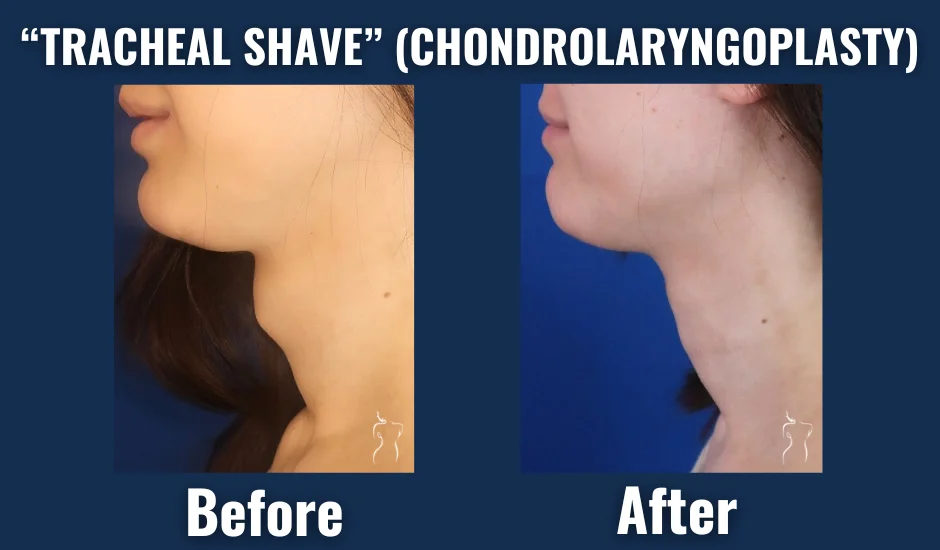
A tracheal shave, also known by its medical name chondrolaryngoplasty, reduces this prominence surgically. Through a small incision placed in a natural neck crease — typically less than 2 centimeters — Dr. Day carefully removes excess cartilage to create a smoother, softer neck contour. No incision is made on the prominent part of the neck itself; the placement is designed for maximum concealment.
Non-surgical approaches — including exercise, skincare regimens, and other treatments — are not able to meaningfully reduce the thyroid cartilage. For patients seeking a visible, lasting reduction, surgery remains the definitive option.
About the Procedure
Medical Name
Chondrolaryngoplasty (KON-dro-LAIR-in-go-PLAS-tee) — from the Greek for cartilage, larynx, and reshaping.
What It Treats
- Prominent thyroid cartilage creating a visible neck 'bump'
- Gender dysphoria related to neck appearance
- Desire for a smoother, more feminine neck profile
- Appearance of a prominent Adam's apple in cisgender women or non-binary individuals
Dr. Day's Surgical Approach
Dr. Day uses a technique that prioritizes both cartilage reduction and voice preservation. He carefully assesses the relationship between the thyroid cartilage and the overlying vocal cords before removing any tissue — an important consideration that sets craniofacial-trained surgeons apart. The incision is placed in a horizontal skin crease for maximum concealment, and the resulting scar typically becomes well-camouflaged within months of recovery.
Lay Names
Tracheal shave, Adam’s apple reduction, Adam’s apple surgery, throat feminization.
"I went to Dr. Day's office for facial feminization surgery, and I don't think I could be happier with the results!During our initial consult, he took the time to understand my wants, but also helped me understand some of the anatomical differences between 'male' and 'female' faces and some of the surgical options we had for addressing my face. I would highly recommend Dr. Day, especially to any of my trans sisters who may be having a hard time finding someone covered by insurance in a reasonable timeframe…"
Benefits of a Tracheal Shave
For many patients, a prominent Adam’s apple is one of the most visible and dysphoria-inducing features they face daily. It can be difficult to conceal with clothing, and it often draws attention regardless of other aspects of appearance.
A tracheal shave addresses this directly, and the impact is frequently described by patients as transformative beyond its physical scale.
Physical Benefits
- Permanent reduction of thyroid cartilage prominence
- Smoother, softer neck profile visible even in open necklines
- Minimal and concealed incision — placed in natural neck crease
- Outpatient procedure — typically completed in under 90 minutes
- Manageable recovery — most patients return to desk work within the first week and full activity by weeks 4–6
- No change to voice when performed by an experienced, anatomy-aware surgeon
Quality of Life Benefits
- Reduced gender dysphoria related to neck and throat appearance
- Increased confidence in clothing choices — V-necks, open collars, swimwear
- Enhanced alignment between internal gender identity and external appearance
- Often performed as a standalone procedure — no need for larger surgical combination
- Can be combined with other FFS procedures for a single recovery period
- Washington insurance may cover costs when medically indicated for gender dysphoria
Am I a Good Candidate for a Tracheal Shave?
The best candidates for tracheal shave are individuals who are bothered by the appearance of a prominent Adam’s apple and are in good general health for an outpatient surgical procedure. Dr. Day evaluates each patient individually during a private consultation, with no judgment and no assumptions about your goals.
- Ideal Candidates
- Bothered by a prominent Adam's apple or visible thyroid cartilage
- Seeking a smoother, more feminine neck contour
- In good general health with no uncontrolled medical conditions
- Non-smoker, or willing to stop smoking for at least 4 weeks before and after surgery
- At or near a stable weight — significant weight changes after surgery can affect results
- Have realistic expectations about results and recovery
- When to Wait
- Active smoker unwilling to pause — nicotine significantly impairs healing
- Uncontrolled thyroid or laryngeal conditions that require medical management first
- Significant current illness or recent major surgery — allow adequate recovery time
- Planning significant weight loss — wait until weight is stable
- Seeking simultaneous voice surgery — procedures should be staged appropriately
- Unrealistic expectations about the degree of change possible from a single procedure
Not Sure If You're a Candidate?
Schedule a consultation with Dr. Day to discuss your goals and options.
Your Tracheal Shave Journey
Step 1 — Your Consultation
Your consultation with Dr. Day is a private, unhurried appointment. He will review your anatomy, discuss your goals, explain the surgical approach in detail, and answer every question you have. If you are navigating insurance coverage, our patient care coordinator will assist you with pre-authorization paperwork. There is no judgment, and no pressure to make any decision before you’re ready.
Step 2 — Pre-Surgery Preparation
Once you’ve decided to move forward, you’ll receive detailed pre-operative instructions covering all medications, supplements, and lifestyle factors to address before surgery — including nicotine cessation (at least four weeks prior), fasting instructions, and guidance on any prescriptions that may need to be paused. Medications are adjusted for a range of reasons including bleeding, healing, anesthesia safety, and DVT prevention. If you take GLP-1 medications such as semaglutide or tirzepatide, you will pause these for two weeks before surgery; Dr. Day will confirm the exact stop date during your pre-operative review.
Step 3 — Day of Surgery
Tracheal shave is performed as an outpatient procedure at one of Dr. Day’s accredited surgical facilities in the Bellevue area. You will receive anesthesia (typically general or deep sedation), and the procedure itself typically takes 45 to 90 minutes. A small incision is made in a horizontal neck crease, excess thyroid cartilage is carefully removed, and the incision is closed with fine sutures. You will recover briefly in the facility before going home — a responsible adult must drive you and remain with you the first night.
Step 4 — Recovery Timeline
Day 1 (Day After Surgery):
What to Expect
Low-grade activity is encouraged — short walks are appropriate. Keep head slightly elevated. Soft foods are recommended. Avoid any activity that causes grimacing, straining, or sweating. Mild soreness and swelling in the neck area is expected and well-managed with prescribed medication.
Week 1
What to Expect
Most patients are largely recovered by the end of the first week. Sutures are typically removed or dissolve by the end of this week. Most patients return to desk work or remote work during this period. Continue to avoid any exertion that causes grimacing, straining, or sweating..
Weeks 2
What to Expect
Most patients return to their normal routine, with restrictions on heavy lifting or activities that strain the neck until cleared by Dr. Day.
Ongoing
What to Expect
Continue scar care as directed. Scar maturation continues over the following 6–12 months.
Step 5 — Follow-Up Care
Dr. Day personally follows up with his patients after surgery. You’ll have a follow-up appointment within the first week, and additional check-ins as needed. Dr. Day’s office is available for questions at any stage of recovery — your access to the care team does not end when you leave the surgical facility.
Does Insurance Cover Tracheal Shave in Washington?
One of the most common questions patients ask before scheduling a consultation is whether their insurance will cover tracheal shave surgery. The answer, for many Washington patients, is yes — or at least possibly.
What Affects Coverage?
- Documentation of gender dysphoria by a licensed mental health professional
- A letter of medical necessity from a qualified provider
- Prior authorization from your insurer before the procedure
- Your specific plan type and benefit structure
- Whether Dr. Day is in-network for your plan
How Pacific Sound Helps
Navigating insurance for gender-affirming care can be complex. Our patient care coordinator has direct experience with pre-authorization processes for gender-affirming procedures and works closely with patients to submit the documentation insurers require. Insurance pre-authorization typically takes at least 4–6 weeks, and the process can only be initiated after your surgical consultation with Dr. Day. We assist with insurance navigation as part of your care — you do not face this process alone. If your insurance does not cover this procedure, or if you are self-paying, financing options through CareCredit (6-month promotional financing) and Alphaeon Credit are available for qualified applicants.
What Results Can I Expect from a Tracheal Shave?
When Will I See Results?
Initial swelling in the neck area resolves significantly within the first two weeks. Most patients see their result taking shape by weeks three to four. The final result — including full scar maturation — emerges over 6 to 12 months. Many patients describe the change as immediately noticeable even during early recovery, as the prominent cartilage is no longer visible through the skin.
How Long Do Results Last?
Tracheal shave removes cartilage for long-lasting results. The thyroid cartilage does not regenerate. Your result is designed to be long-lasting — the neck contour you achieve through this procedure will remain your baseline. Over time, natural aging of the skin and soft tissue continues, but the underlying cartilage reduction is irreversible.
Scar Appearance
The incision for tracheal shave is placed in a horizontal neck crease specifically chosen for concealment. For most patients, the scar becomes difficult to detect within 3 to 6 months as it matures and lightens. Dr. Day’s use of fine suture technique and precise wound closure is designed to minimize scar visibility from the outset.
Tracheal Shave Cost at Pacific Sound
The cost of tracheal shave surgery varies depending on whether your procedure is covered by insurance, the specific surgical plan developed for your anatomy, and any additional procedures performed at the same time. Dr. Day and our patient care coordinator will discuss all cost details privately during your consultation.
Factors That Affect Cost
- Insurance coverage and your individual benefit structure
- Standalone procedure vs. performed as part of a larger FFS combination
- Anesthesia type and surgical facility fees
- Any pre-operative imaging or testing required by your plan
- Post-operative care and follow-up visits
What’s Included in Your Tracheal Shave Investment
Your surgical fee covers all of the following at Pacific Sound Plastic Surgery:
- Surgeon's fee
- Facility / operating room fee
- Anesthesia (administered by a board-certified anesthesiologist or certified registered nurse anesthetist)
- Enhanced Recovery After Surgery medication (Exparel)
- Cosmetic surgery insurance coverage (Cosmetasure)
- High-end compression garment (Isavella)
- High-end scar ointment (Biocorneum)
- Swelling and bruising ointment (Arnica)
- Clara Recovery Supplements
- Chlorhexidine Anti-Septic Scrub Cloths
- Post-operative recovery and follow-up care
Financing Options
Pacific Sound Plastic Surgery accepts CareCredit (6-month financing) and Alphaeon Credit, two of the most widely used healthcare financing programs. Both allow patients to begin their journey without paying the full cost upfront.
Starting from $3,500
Pricing is discussed in full detail during your consultation so there are no surprises. Call (425) 818-8991 to get started.
Why Patients Choose Dr. Day for Tracheal Shave in Bellevue?
Tracheal shave is a procedure that requires precise anatomical knowledge of the larynx, the thyroid cartilage, and — critically — the underlying vocal cords. The margin between the cartilage that can be safely removed and the structures that must be protected is small. Dr. Day’s craniofacial fellowship training is uniquely relevant here.
The Only Craniofacial Fellowship-Trained Plastic Surgeon in Bellevue
Dr. Day’s craniofacial fellowship training — a subspecialty pursuit beyond standard plastic surgery residency — encompasses advanced facial bone and cartilage anatomy, reconstructive techniques, and the structural understanding that translates directly to safer, more precise procedures like tracheal shave. His Ivy League background in surgery further deepens this foundation. No other plastic surgeon in the Bellevue market holds this credential.
A Practice Built on Respect and Discretion
Pacific Sound Plastic Surgery is a boutique practice. Every patient receives Dr. Day’s personal attention from their first consultation through their final follow-up. Dr. Day performs his own consultations, surgical procedures, and post-operative care — you are never passed off to staff for clinical decisions. For transgender and non-binary patients, this means your care is consistent, personal, and delivered with the same respect at every touchpoint.
Credentials That Matter
- Double Board-Certified — American Board of Plastic Surgery (ABPS) + American Board of Surgery (ABS)
- Ivy League Trained
- 30+ Peer-Reviewed Publications
- Member: American Society of Plastic Surgeons (ASPS), ASAPS, FACS
- Surgical Facilities: Swedish Medical Center, Carillon Point Surgery Center, Virginia Mason Franciscan Health, Sound Plastic Surgery Center
- Highly Rated Bellevue Plastic Surgeon
- 10+ Years in Practice
Credentials That Matter
"I was referred to Dr. Day for my gender-affirming top surgery and having heard very little about him, I was hesitant. From the first consultation, Dr. Day was very clear and honest with me about what I could expect from the procedure. His explanations were extremely thorough and he answered all of my questions thoughtfully. Dr. Day went out of his way to make me feel comfortable and accepted, going as far as politely correcting nurses at the hospital on my pronouns on multiple occasions… The results are so much better than I could have expected. Dr. Day is a very professional and experienced surgeon, and I highly recommend him to anyone looking for gender-affirming surgery."
— Alex T., Gender-Affirming Surgery Patient · Google Review





Conveniently Located for Eastside Families
Pacific Sound Plastic Surgery is centrally located in downtown Bellevue, making Dr. Day’s fellowship-trained expertise accessible to families throughout Bellevue and the greater Eastside — without the stress of navigating Seattle traffic. Our patients enjoy a private, boutique surgical experience with on-site validated parking, just minutes from the communities they call home.
Seattle
~15 minutes
World-class plastic surgery results without the downtown Seattle parking hassle. A quick drive across SR-520 or I-90 to our private Bellevue office.
Kirkland
~10 minutes
Just minutes from downtown Kirkland and the Juanita waterfront via I-405 or surface streets.
Redmond
~10 minutes
Convenient for the Redmond tech community via SR-520 or surface streets.
Mercer Island
~10 minutes
A quick drive across I-90. Our discreet, private environment is ideal for discerning Mercer Island residents.
Issaquah
~10 minutes
Convenient for Issaquah Highlands and Gilman Village area families via I-90.
Renton
~5 minutes
Easy access from Renton and the Landing via I-405 North. Boutique care and personalized attention just minutes away.
Frequently Asked Questions
Will a tracheal shave affect my voice?
How visible will the scar be?
Dr. Day places the incision in a horizontal neck crease — a natural fold in the skin that serves as a natural hiding place for the scar. For most patients, the scar becomes well-camouflaged within 3 to 6 months of surgery as it heals and matures, often becoming difficult to detect in everyday viewing. Scar healing varies by individual skin type and adherence to post-operative scar care.
How long does the procedure take, and is it outpatient?
What is the recovery like, and when can I return to work?
Tracheal shave is a short, focused operation, and most patients return to desk work or remote work within the first week. The first few days involve mild soreness and swelling in the neck area, with discomfort well-managed by prescribed medication. Soft foods are recommended initially; avoid straining the neck. Most patients return to their normal routine by the second week, with restrictions on heavy lifting and activities that strain the neck until Dr. Day clears you. Scar healing continues over the following several months.