Forehead Reduction in Bellevue
Achieve a Naturally Balanced Facial Profile
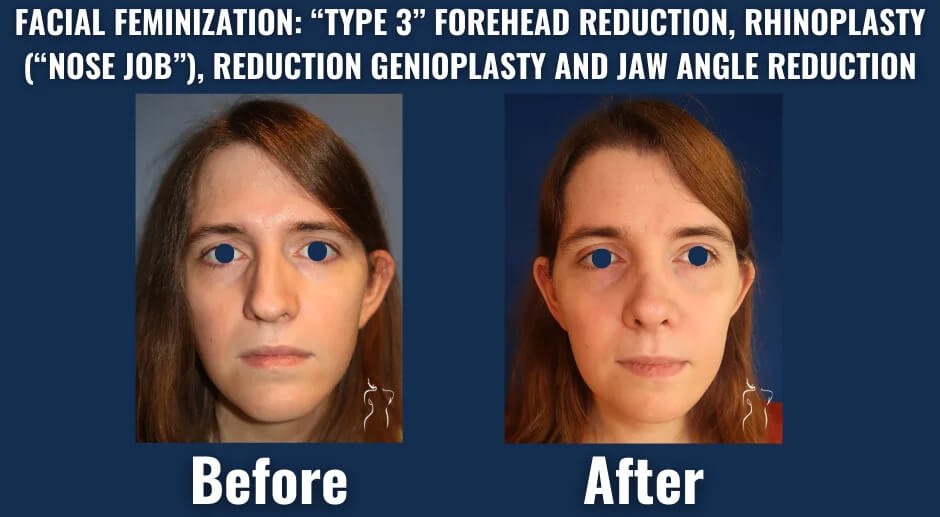
A prominent forehead — particularly heaviness across the brow bone and glabella — can feel disproportionate to the rest of your face. Forehead reduction surgery is a facial bone procedure that sets back the frontal bone to reduce the projection of the glabella and the heaviness of the superior orbital (brow) rims, creating more balanced facial proportions. It is often combined with hairline lowering (scalp advancement) and/or brow lift, but these are three distinct procedures with three distinct goals. At Pacific Sound Plastic Surgery in Bellevue, Dr. Kristopher M. Day combines his rare craniofacial fellowship training with meticulous surgical precision to deliver natural-looking results with well-concealed incisions.
Double Board-Certified (ABPS + ABS)
Ivy League Trained
Highly Rated Bellevue Plastic Surgeon
Proudly Serving Bellevue, Seattle, Kirkland, Redmond, Mercer Island, Issaquah, Renton

What Is Forehead Reduction Surgery?
Forehead reduction surgery is a facial bone procedure that sets back the frontal bone — softening the projection of the glabella and the heaviness of the superior orbital (brow) rims — to create more harmonious facial proportions. It is one of three closely related procedures that are often combined into a single operation:
How It Works — The Technique
Dr. Day uses one of two incision approaches depending on your anatomy and goals:
- Pre-trichial incision — placed just in front of the hairline, used when hairline advancement is part of the plan
- Coronal incision — placed within the hair-bearing scalp, more concealed but does not allow the hairline to move forward
Through the chosen approach, Dr. Day sets back the frontal bone to reduce the projection of the glabella and the heaviness of the superior orbital rims. If hairline lowering is part of the operation, a measured segment of forehead skin is also removed and the scalp is advanced forward by typically 1–3 centimeters. The incision is closed with meticulous technique so the scar is well-concealed within the hairline or hair-bearing scalp as hair grows in.
Because this is a procedure involving the facial skeleton, Dr. Day’s craniofacial fellowship training is a significant advantage. His deep understanding of facial bone structures, soft tissue planes, and both the motor and sensory nerves of the forehead allows for precise, safe execution.
Forehead Reduction vs. Brow Lift — Understanding the Difference
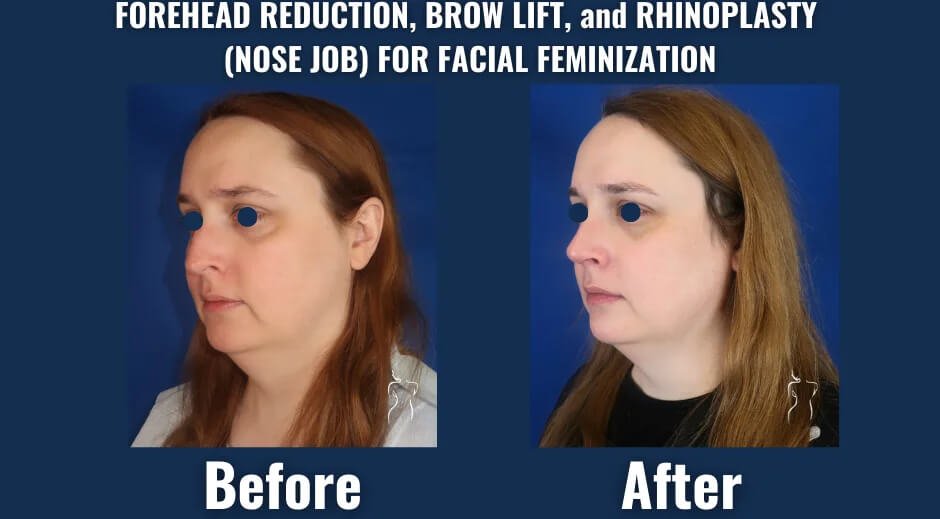
These two procedures are frequently confused but address different concerns. A brow lift raises the position of the eyebrows to reduce forehead wrinkles and hooding over the eyes — it does not address the bony forehead. Forehead reduction sets back the frontal bone to reduce the projection of the glabella and the heaviness of the brow rims; it is often combined with hairline lowering when the patient also wants to move the hairline forward. Some patients benefit from both forehead reduction and brow lift, which can be combined in a single surgical session.
"My scarring is so unnoticed, people comment on how it looks like no surgery marks at all."
— Sarah B., Facial Procedure Patient • Google Review
Benefits of Forehead Reduction Surgery
For patients who have felt self-conscious about a prominent or disproportionately tall forehead, forehead reduction surgery can be genuinely life-changing. The change to facial balance is visible immediately and tends to affect how patients see themselves in mirrors and photographs for years to come.
Aesthetic & Proportional Benefits
- Reduces forehead projection through bony setback, with long-lasting results — most are lifelong
- Creates a more harmonious balance between forehead, midface, and lower face
- Softens the appearance of a prominent or overpowering brow region
- Natural-looking results — no one can tell you've had surgery, only that you look better
- Can eliminate or dramatically reduce reliance on hair bangs or styling workarounds
Confidence & Emotional Benefits
Many patients describe forehead reduction as one of the most impactful changes they could make to their appearance — not because it is dramatic, but because it addresses a proportion that has quietly bothered them for years. The result tends to feel natural and harmonious rather than ‘done.’
Practical Benefits
- Single outpatient procedure — performed in one session
- Relatively straightforward recovery compared to more extensive facial surgeries
- Long-lasting result — does not require maintenance procedures
- Can be combined with brow lift, rhinoplasty, or other facial procedures in one session
Long-Lasting, Natural-Looking Results
The results of forehead reduction surgery are long-lasting. Once the frontal bone is set back and the soft-tissue envelope repositioned, the change to facial proportions is enduring — most results are lifelong, with no maintenance procedures required. Patients can expect to look proportionately balanced and naturally refreshed for the long term.
"I went to Dr. Day’s office for facial feminization surgery, and I don’t think I could be happier with the results! During our initial consult, he took the time to understand my wants, but also helped me understand some of the anatomical differences between ‘male’ and ‘female’ faces and some of the surgical options we had for addressing my face."
— Michelle D., Facial Feminization Patient • Google Review
Am I a Good Candidate for Forehead Reduction Surgery?
The best candidates for forehead reduction surgery are healthy adults who want to reduce forehead projection — softening the glabella and brow rim heaviness — and improve facial balance. Dr. Day assesses your forehead anatomy, scalp laxity, and hair pattern at your consultation. Thinning hair is not an absolute contraindication; alternative incision approaches, hair transplant coordination, or hair rejuvenation therapies can often be incorporated into the surgical plan.
- Ideal Candidates
- Good overall health with no uncontrolled medical conditions
- Forehead height greater than ~6 cm that feels disproportionate
- Stable hair pattern (or willing to coordinate hair rejuvenation, medical therapy, or hair transplant if needed)
- Adequate scalp laxity to allow advancement (assessed at consultation)
- Non-smoker, or committed to stopping 4+ weeks before and after surgery
- Realistic expectations about outcome and recovery
- When to Wait
- Unstable or rapidly progressing hair loss not yet evaluated by a hair-loss specialist
- Planning significant future weight changes (can affect facial proportion)
- Currently pregnant or nursing
- Recent scalp surgeries, scars, or prior hairline procedures in the area
- Expecting dramatic results — this is a proportional refinement, not a transformation
- Unresolved skin conditions affecting the scalp or forehead area
Not Sure If You're a Candidate?
Schedule a consultation with Dr. Day to discuss your goals and options.
Your Forehead Reduction Journey
Your Consultation with Dr. Day
Your consultation begins with a thorough assessment of your forehead anatomy, scalp laxity, and hairline position. Dr. Day will measure your forehead height, evaluate how much advancement is anatomically achievable, and discuss the expected result in realistic terms. He will also review your hair quality and growth patterns to ensure the incision will heal with natural camouflage over time.
There is no pressure — the consultation is a conversation. Dr. Day will answer all your questions, address any concerns, and help you decide whether this procedure aligns with your goals. If a combination approach (such as adding a brow lift) would enhance your result, he will explain why and let you decide.
Preparing for Surgery
- Stop smoking at least 4 weeks before surgery — smoking significantly impairs wound healing and scarring
- Avoid blood-thinning medications and supplements (aspirin, ibuprofen, fish oil, vitamin E, and others as listed in your pre-operative instructions) for at least 2 weeks prior
- Arrange for a trusted adult to drive you home and stay with you the first night
- Prepare your recovery space: loose-fitting clothing, head-elevated sleeping setup, easy-to-prepare meals
- Do not wash or use products in your hair day-of surgery
The Day of Your Procedure
Forehead reduction is performed under general anesthesia. As a bony surgical procedure, general anesthesia is the routine standard of care. Surgery typically takes 2–3 hours. Dr. Day makes a precisely planned incision — either pre-trichial (in front of the hairline) or coronal (within the hair-bearing scalp), depending on your surgical plan — performs the frontal bone setback, addresses the soft-tissue envelope, and closes the incision with meticulous suture technique. Most patients are admitted overnight for monitored recovery; your discharge plan will be reviewed with you in advance.
Recovery Timeline
Day 1-3
What to Expect
Walking is encouraged starting the day after surgery. Head elevation recommended. Mild swelling and tightness are normal. Hair washing resumes approximately 2 days after surgery, per Dr. Day’s instructions. No grimace, grunt, strain, or sweat-inducing activity.
Week 1
What to Expect
Sutures in place. Mild bruising possible around the hairline. You will be seen for your first post-op check. Desk and sedentary work can typically resume. No bending, straining, or lifting.
Weeks 2-4
What to Expect
Sutures removed (typically day 7–10). Swelling continues to resolve. Progressively resume exertional activity — start at 50% of pre-operative baseline and increase by approximately 5% per day.
Weeks 4-6
What to Expect
Full return to pre-operative baseline. Unrestricted activity, including strenuous exercise, resumes. Continue protecting the incision area from direct sun exposure to support optimal scar maturation.
Months 2–6
What to Expect
The incision scar continues to mature and fade. Hair grows in along the incision line, progressively camouflaging the scar. Final hairline position is established.
Follow-Up Care
Dr. Day provides close post-operative follow-up including visits at 1 week, 1 month, and 3–6 months after surgery, with additional appointments as needed. Scar care guidance, including silicone products and sun protection protocols, will be provided to optimize your long-term result.
"Dr. Day is not only extremely professional, he is a expert in this field. Any questions you have, he will know the detailed answer. The whole process from my first appointment, to my procedure, to my follow up was fantastic. 10/10."
— Ian R., Pacific Sound Patient • Google Review
Why Craniofacial Training Matters for Forehead Reduction
Forehead reduction is not a procedure that belongs exclusively in the domain of standard cosmetic surgeons. It requires intimate knowledge of the scalp’s vascular anatomy, the sensory nerve branches of the forehead (supraorbital and supratrochlear nerves), and how the soft tissue of the scalp moves in relation to the underlying periosteum.
A mis-planned incision or inadequate release can compromise scar quality, prolong numbness, or affect hairline position.
Dr. Day is the only fellowship-trained craniofacial plastic surgeon practicing in Bellevue. His craniofacial fellowship trained him in the precise anatomy of the facial skeleton and its surrounding soft tissues. This training, which most cosmetic surgeons simply do not have, informs every aspect of how he plans and executes a forehead reduction.Dr. Day is the only fellowship-trained craniofacial surgeon practicing in the Bellevue market. His craniofacial fellowship trained him in the precise anatomy of the facial skeleton and its surrounding soft tissues. This training, which most cosmetic surgeons simply do not have, informs every aspect of how he plans and executes a forehead reduction.
- Precise incision planning — pre-trichial or coronal — to maximize concealment within the hairline or hair-bearing scalp
- Deep understanding of scalp vascular zones to preserve blood supply during advancement
- Identification and protection of motor and sensory nerve branches to minimize numbness and protect motor function
- Meticulous soft tissue handling to prevent widened or raised scarring
The clinical result: patients consistently remark that their scarring is ‘so unnoticed’ — a direct reflection of the quality of execution that comes from Dr. Day’s specialized training.
"Came in with face fractures with bones floating under my skin. Dr. Day immediately got me into surgery. Reconstructed my face with titanium mesh and removed bones. His stitches were amazing. Nobody would even know that I had this surgery. What a great God Send!"
— Adam L., Facial Reconstruction Patient • Google Review
What Results Can I Expect from Forehead Reduction
When Will I See Results?
The change in forehead projection and hairline position is visible immediately after surgery, even before swelling fully resolves. Initial swelling and mild tightness in the forehead region are normal and typically resolve over the first 2–4 weeks. By 4–6 weeks, you can see your new forehead contour and hairline position clearly.
Full scar maturation — including the progressive camouflage as hair grows in along the incision line — takes approximately 6–12 months, at which point the final result becomes fully apparent.
How Long Do Results Last?
Forehead reduction surgery produces enduring results. Once the frontal bone is set back and the soft-tissue envelope repositioned, the change to facial proportions is long-lasting — most results are lifelong, and no maintenance procedures are required.
Stability depends in part on the patient not subsequently developing progressive hair loss affecting the hairline.
"Very thorough, described potential benefits and drawbacks for each type of approach we discussed. Very professional, skilled, and gentle. No 'upselling' or added services pushed which was a relief! He and his staff are a wonderful addition to our area! Thank you and you did beautiful work!"
— Stacy, Procedure Patient • Google Review
Forehead Reduction Cost in Bellevue
The cost of forehead reduction surgery at Pacific Sound Plastic Surgery depends on several individualized factors that Dr. Day will review with you during your consultation. Our team will provide a detailed, transparent cost breakdown before you make any decisions — there are no surprises.
What Affects Price
- Extent of scalp advancement needed (1 cm vs. 3 cm affects procedure complexity)
- Whether the procedure is performed alone or combined with a brow lift or other facial procedures
- Anesthesia type and duration
- Facility fees at our accredited surgical facilities
- Post-operative care supplies and follow-up visits
What’s Included in Your Forehead Reduction Investment
Your surgical fee covers all of the following at Pacific Sound Plastic Surgery:
- Surgeon's fee
- Facility / operating room fee
- Anesthesia (administered by a board-certified anesthesiologist or certified registered nurse anesthetist)
- Enhanced Recovery After Surgery medication (Exparel)
- Cosmetic surgery insurance coverage (Cosmetasure)
- High-end compression garment (Isavella)
- High-end scar ointment (Biocorneum)
- Swelling and bruising ointment (Arnica)
- Clara Recovery Supplements
- Chlorhexidine Anti-Septic Scrub Cloths
- Post-operative recovery and follow-up care
Financing Options
Pacific Sound Plastic Surgery accepts CareCredit (6-month financing) and Alphaeon Credit, two of the most widely used healthcare financing programs. Both allow patients to begin their journey without paying the full cost upfront.
Starting from $9,500
Pricing is discussed in full detail during your consultation so there are no surprises. Call (425) 818-8991 to get started.
Why Choose Dr. Kristopher M. Day for Your Forehead Reduction
Choosing the right surgeon for forehead reduction is not a decision to make lightly. The procedure demands precise incision planning, careful scalp release, and an intimate understanding of forehead anatomy to achieve a natural, well-healed result. Dr. Day offers a combination of credentials and training that is uncommon among plastic surgeons in Bellevue and the greater Seattle area.
✓ The Only Craniofacial Fellowship-Trained Plastic Surgeon Practicing in Bellevue
Dr. Day’s craniofacial fellowship training is the single most important differentiator for procedures like forehead reduction that involve the facial bone anatomy and complex soft tissue layers. To our knowledge, no other plastic surgeon currently practicing in Bellevue holds this specialized training. This is not a marketing claim — it is a verifiable credential gap that directly benefits patients undergoing facial bone and scalp procedures.
✓Boutique Practice — Your Surgery, Your Surgeon
Pacific Sound Plastic Surgery is intentionally not a high-volume clinic. Every patient works directly with Dr. Day from their first consultation through their final post-operative visit — there is no hand-off to a junior surgeon or rotating provider. This boutique model reflects Dr. Day’s belief that quality outcomes require personal attention.
✓ 30+ Peer-Reviewed Publications
With over 30 peer-reviewed publications, Dr. Day is not only a practicing surgeon but an active contributor to the medical literature. This level of scholarly engagement ensures that his techniques are grounded in the most current evidence base — not outdated protocols.
✓ Double Board-Certified
Dr. Day is certified by both the American Board of Plastic Surgery and the American Board of Surgery — a distinction held by a minority of practicing plastic surgeons and a direct indicator of the depth and rigor of his training and ongoing certification standards.
Surgical Facilities
Swedish Medical Center · Carillon Point Surgery Center ·
Virginia Mason Franciscan Health · Sound Plastic Surgical Center
"Dr Day and staff are wonderful. They care for their patients and strive for the best possible outcome from the procedure. Dr Day informs you step by step, pre surgery and post surgery. Whatever procedure you are looking to have, Dr Day is the best at what he does."
— Karen C., Pacific Sound Patient • Google Review







Conveniently Located for Eastside Families
Pacific Sound Plastic Surgery is centrally located in downtown Bellevue, making Dr. Day’s fellowship-trained expertise accessible to patients throughout Bellevue and the greater Eastside — without the stress of navigating Seattle traffic. Our patients enjoy a private, boutique surgical experience with convenient on-site parking, just minutes from the communities they call home.
Seattle
~15 minutes
World-class plastic surgery results without the downtown Seattle parking hassle. A quick drive across SR-520 or I-90 to our private Bellevue office.
Kirkland
~10 minutes
Just minutes from downtown Kirkland and the Juanita waterfront via I-405 or surface streets.
Redmond
~10 minutes
Convenient for the Redmond tech community via SR-520 or surface streets.
Mercer Island
~10 minutes
A quick drive across I-90. Our discreet, private environment is ideal for discerning Mercer Island residents.
Issaquah
~10 minutes
Convenient for Issaquah Highlands and Gilman Village area families via I-90.
Renton
~5 minutes
Easy access from Renton and the Landing via I-405 North. Boutique care and personalized attention just minutes away.
Frequently Asked Questions
How much does forehead reduction surgery cost in Bellevue?
Pricing starts at $9,500, which includes brow lift if combined. Your exact estimate is based on the extent of bony setback and any soft-tissue advancement, and will be provided during your consultation with Dr. Day. Please note that cosmetic procedures are generally not covered by insurance, though gender-affirming components may be covered in some cases.
How much can my hairline be lowered?
Most patients can achieve a hairline advancement of 1–3 centimeters, depending on scalp laxity — the amount of natural looseness in your scalp that allows it to be moved forward safely. Dr. Day assesses scalp laxity at your consultation as a primary factor in determining realistic outcomes. Patients with very tight scalps may be candidates for a tissue-expander approach or phased surgery.
Am I a candidate for forehead reduction if I have thinning hair?
Thinning hair is not an absolute contraindication. Dr. Day has several pathways for patients with hair loss concerns: alternative incision placement (such as the coronal incision within the hair-bearing scalp), coordination with hair transplant, or hair rejuvenation and medical hair-loss therapies before or after surgery. The right approach depends on the pattern and stability of your hair loss, which Dr. Day will assess during your consultation.
Will the scar be visible?
Dr. Day places the incision carefully — either pre-trichial (in front of the hairline) or coronal (within the hair-bearing scalp) — so that as hair grows in, it progressively camouflages the incision line. With appropriate scar care protocols — which Dr. Day provides — the scar typically becomes well-concealed within 3–6 months. His craniofacial fellowship training informs the precision of his closure technique, which directly affects long-term scar quality. Scars are optimized, meticulously created, and camouflaged within the hairline — not invisible.
Can forehead reduction be combined with other procedures?
Yes. Forehead reduction is frequently combined with a brow lift — which raises the eyebrows — as well as rhinoplasty or other facial procedures. Combining procedures can be appropriate and advantageous, reducing your total recovery time compared to multiple separate surgeries. Dr. Day will evaluate which combination, if any, makes clinical and aesthetic sense for your goals.
How long is recovery after forehead reduction surgery?
Walking is encouraged starting the day after surgery. Most patients return to desk and sedentary work within the first week. Light exercise can resume gradually at weeks 2–4, starting at 50% of pre-operative effort and increasing progressively. Full unrestricted activity, including strenuous exercise, typically resumes by weeks 4–6. The scar continues to mature and fade for up to 6 months as hair grows in along the incision line.
Does forehead reduction affect sensation in my forehead?
Some temporary numbness in the forehead and scalp area is common and expected as the sensory nerves adjust following surgery. Dr. Day’s craniofacial training includes precise identification and protection of both the motor and sensory nerve branches — particularly the supraorbital and supratrochlear nerves — which minimizes the duration and severity of any post-operative numbness and protects motor function. In most patients, normal sensation returns within several weeks to months.
What is the difference between forehead reduction and a brow lift?
These are three distinct procedures that are often combined into a single operation but are not the same thing:
– Forehead reduction — a bony procedure that sets back the frontal bone to reduce the projection of the glabella and the heaviness of the superior orbital (brow) rims
– Hairline lowering (scalp advancement) — a soft-tissue procedure that moves the hairline forward by advancing the scalp
– Brow lift — raises the position of the eyebrows on the face
Each can be performed independently. They are most often combined when patients have multiple goals across the upper face. During your consultation, Dr. Day will explain which procedure — or which combination — addresses your specific anatomy and aesthetic goals.
Can forehead reduction surgery be performed as part of FFS (Facial Feminization Surgery)?
Yes. Forehead reduction and hairline lowering are among the most commonly requested components of facial feminization surgery. Dr. Day has significant experience performing these procedures as part of comprehensive FFS treatment plans, and his craniofacial fellowship training makes him uniquely qualified. Insurance coverage for FFS-related procedures varies — our team can assist with pre-authorization inquiries if applicable.
How is recovery different if I combine forehead reduction with a brow lift?
There is no meaningful difference in recovery when forehead reduction is combined with a brow lift. Both procedures operate in the same anatomical region and share the same recovery protocol. The decision to combine them is based on your aesthetic goals, not recovery considerations. Acute swelling is most prominent in the first week and typically resolves over 2–3 weeks; chronic edema resolves over 2–3 months.
How do I know if Dr. Day is the right surgeon for my forehead reduction?
Dr. Day is the only craniofacial fellowship-trained plastic surgeon practicing in Bellevue — a training background that is specifically relevant to forehead and scalp anatomy. He is double board-certified, Ivy League trained, and has 30+ peer-reviewed publications to his name. The best way to determine fit is to schedule a consultation, during which he will assess your anatomy, answer your specific questions, and give you an honest recommendation. Call (425) 818-8991.